Showing posts with label food. Show all posts

Saturday, October 10, 2015

Bibimbap


Bibimbap (비빔밥, literally "mixed rice") is a Korean dish that consists of a bowl of warm rice topped with vegetables, and sometimes egg or meat. Sauce (typically gochujang, chili pepper paste) is added and everything mixed together before eating.

When I had this dish in Seoul, the vegetables were all raw and the only sauce was gochujang, so I didn't enjoy it very much. It seems, however, that the vegetables are supposed to be sautéed and seasoned, and bibimbap is widely considered one of the world's most delicious foods! Anastasia prepared bibimbap recently along with two friends of hers, and I have to say, it was delicious.

In the above photo fried carrot, zucchini, and scallion are joined by cucumber and pickled radish, with lightly fried bean sprouts arranged in the center. Sesame seeds are sprinkled on top, and what you can't see under the vegetables are the layer of minced meat and the generous portion of white rice that serves as a base for it all. Mix it all together and voila! You have a delicious, and flavorful meal. Gochujang is optional.

Thursday, July 2, 2015

What (and Where!) to Eat in Madrid

Bocata de jamon - often a bit of olive oil is added, and the taste is incredible.
Jamón. That is the best thing to start this post with.
A good jamon is tough, yet easy to bite, has lots of white, fatty parts, and the most amazingly intense, salty meat. Sliced finely, it's delicious on its own or slipped into bread, and don't limit yourself to the regular crisp bread seen above! If you're in Madrid, you should definitely try the jamon in a sweet croissant - the combination of textures and tastes is something you won't find anywhere else.
If you're looking for jamon, there are a bunch of jamon stores around Plaza del Sol that can offer you a huge variety of different types, the most popular being Jamon Iberico. Most of these stores will sell ready-made bocatas - I had one just today, picked up from a shop on Calle Tetuán, just across from the Bijou Brigitte.

Pan con tomate!
Also popular on bread is tomato - finely chopped and mixed with olive oil, garlic, salt and pepper, it's something typically enjoyed in the morning with your coffee. It's tangy, sweet, mild enough to eat first thing in the morning, and tastes sublime. Typically served on crunchy, toasted bread, it's a very satisfying dish to bite into. Go for any small cafe or tavern and you're likely to find it!

Gambas al ajillo have to look like this - arrive in a brown, piping hot bowl, covered in garlic and spices and with plenty of flavorful oil to soak your bread in.
Gambas al ajillo have to be one of my favorite things to eat in Madrid, and you have to be sure to go to the right kind of place to get these. Taverns that all the locals flock to (easily recognized by the huge throng of people filling them around 11PM) tend to do this dish right. Personally, if I want perfect gambas al ajillo, I go to a tavern in San Bernardo that doesn't even show up on Google - just off the metro station on the corner of Calle San Bernardo and Calle Sandoval is a traditional tavern that does everything right. Get yourself a glass of wine or beer and order gambas al ajillo, huevos rotos con jamon, croquetas and whatever else your heart desires. The waiters are tons of fun, you don't have to wait for service, and the food is spot-on! If you want proper gazpacho, go here for that, too.

Tortilla de patatas - hot or cold, this is a delicious dish!
Tortilla. What would a visit to Spain be without it? Strangely, I'd advise you to go to the cheapest place possible for good tortilla: The kind of place that sells you a bottle of coke and a slice of tortilla for a euro or so, the tortilla already ready-made next to other cheap dishes in a central bar area. There's a suitable place off Tirso de Molina, on the corner of Calle de Mesón de Paredes and Calle Encomienda. Again, a place you can't find on Google maps!

It's hard to find natillas in a restaurant, but easy in a supermarket!
All the photos so far have distinct red and yellow notes - the colors of Spain! This dish, too, has those colors, and is just as delicious as the above dishes, albeit a lot sweeter. Vaguely reminiscent of eggnog and vanilla pudding, natillas are creamy and dusted with cinnamon, then topped with a cookie. The cookie gets quite soft, turning into crumbly, mushy deliciousness, and it's definitely something to try if you're in the area! More well-known and easy to find is flan de huevo, which almost all restaurants have. I still prefer the cheap supermarket versions!

Aceitunas surtido - a mix of olives, mini pickles, and tiny onions, all pickled in the same sauce. Delicious, and so tangy!
Olives and other sour bites are wonderful, and flavored differently here than anywhere else in the world. If you go somewhere to have a beer, they're likely to bring you either a plate of chips or olives, but that's not the only place you can get them! I recommend going to the El Corte Ingles off Plaza del Sol, head to the bottom floor, and pick out a bunch of different pickled goods from the big island. Olives, pickles, onions, eggplant, even fish - all for quite cheap prices, and often so tangy that you'll pull a face when you take the first bite. Enjoy them with beer, Aquarius, or Martini - a bocata de jamon is the perfect companion to these sour morsels.

A jug of sangria is perfect with company - otherwise, you may want to stick to a glass!
Then, there's Sangría. I have only one piece of advice for you when it comes to this drink: Do not get it in the Retiro. Oh, it's lovely to drink a nice, cold jug of fruity wine in the park, but unfortunately, they probably just use the cheap supermarket stuff. It's just not worth it. Instead, wander along the side streets of Madrid (try the area just south of Sol) until you find a tavern that's sufficiently busy and settle down for a proper jug of the chilled drink, a plate of chips and the bustling noise of Madrid. There's no place quite like it.

What are your favorite things to eat in Madrid? There are so many delicious options to choose from, but those are some of my top dishes.

Tuesday, June 30, 2015

Gazpacho

It's getting toasty here, and what better to have on a hot day than chilled soup? Gazpacho is one of the simplest things to make - you simply chop up ingredients, dump them in a blender, and add seasoning to taste. Doesn't get much easier!
Now, I won't claim to make the best gazpacho I've ever tasted, but I'd like to think that my years living in Spain ensure that the taste and consistency is accurate.

To make a blender full of gazpacho (enough for the whole family), you'll need these ingredients:

2 pieces of toast soaked in water (stale bread is traditional)
7 medium-sized tomatoes
2/3 cucumber
1 red pepper
1/2 red onion
1 large garlic clove
1 gram pepper
olive oil, sherry vinergar, white wine vinegar and salt to taste.

Basically, just blend all the chopped-up ingredients together and add as much of the other ingredients as you like! Start with small quantities and work your way up. Set it in the fridge to chill, and enjoy! Delicious and simple.

Wednesday, April 22, 2015

Enhanced Illustration - Pencil, Pen, Paint and Pixels

Last week I was in London for a short course at Central Saint Martins. Part of the University of the Arts London, CSM is best known for its fashion department, having helped to prominence notable alumni such as Alexander McQueen, Sarah Burton, John Galliano, and Zac Posen (among many other notable fashion designers). But far from preferring the fashion department over all others, CSM has a huge variety of courses - and a truly excellent selection of short courses.

Tempted by several of their offers, I finally settled on a course titled "Enhanced Illustration - Pencil, Pen, Paint and Pixels". The course description promises to teach students to manipulate and combine hand-drawn elements in Photoshop, "all the while mantaining a personal, hand-crafted look to your resulting illustrations". As you'll have noticed from previous blog entries, I enjoy combining traditional and digital elements (the Japanese Tea Ceremony illustration comes to mind), but I booked this course when I hadn't yet started fiddling around with things much on my own, and had hoped to learn from this course the best methods to clean up a sketch and combine elements.

Now, I had learned a fair amount of this during my studies at the IADE Madrid, but I felt I was still lacking in professionalism. Unfortunately(?), in the months between booking the course and taking it, I played around a lot with Photoshop and my own drawings, finding that cleaning up my sketches tended to work better with ctrl+M (Curves) than fiddling with Brightness and Contrast, and that layering colors over lineart worked really well with a layer style called Multiply. (I spent quite some time playing around with all the layer styles to find out how they'd react - time well spent!) Imagine my dismay when the only Photoshop things the course really focused on were Brightness and Contrast, Hue/Saturation (ctrl+U), and Multiply! The rest was all taking scanned traditional elements and rearranging them in Photoshop.

So I didn't learn anything about Photoshop during the course - but I still found the course immensely interesting, and at times quite illuminating. The instructor, Bill Wright, was an excellent lecturer, bringing in videos, examples of previous students' work, and even other people to help and inspire us. While I didn't learn anything new about Photoshop, I learned about a professional illustrator's work, what different types of illustration there are, and tried out forms of illustration I had never tried previously - such as newspaper illustration.


For that project, we were each allowed to choose a newspaper article from a selection Bill brought along, and then had to present him with a concept before moving on to create a fitting illustration. He approved my concept for this tennis-themed article with little discussion, but gave me a lot of useful feedback during the process of creating the final illustration. The most valuable advice was to crop the image, zooming in and focusing on the action - and it really pulled it together. Before I cropped it, it looked something like this:


Still cute, but... nowhere near as good. (I also did away with the clouds.)

Then, there were all the other students. All female but for one lone male, we all came from different professions and walks of life, with people hailing from the UK, Germany, Chile, Jordan, and other countries. Twice during the week we printed out the work we'd done that far and gave each other feedback, saying what we thought turned out well and, sometimes, what we thought wasn't so great. For many pieces I found my tastes didn't quite match those of most others, but that made it quite interesting, actually.

I asked my two favorite artists there to let me share their projects on my blog, so check this out: Our first assignment was to take the concept 'kitchen' and draw objects, later assembling those into a colorful composition in Photoshop. Here's my end result, followed by the work of Dina Fawakhiri (from Jordan) and Bernardita Errázuriz (from Chile).

Sophie-Therese Lupas
Dina Fawakhiri
Bernardita Errázuriz
Aren't theirs gorgeous? Mine pales in comparison, though the image is refreshing when on its own. Dina and Bernie used such vibrant colors and powerful compositions - and I love the bold lineart.

They also gave me permission to post their final projects, for which we were to create at least two illustrations with a common theme and present them on the final day of the course. I chose to illustrate the hostel I was staying at (click on the images to see them bigger):


Dina did three beautiful illustrations with a theme of finding one's way to a woman's heart:


And Bernardita did a lovely collection of illustrations based on her family.


Lovely, aren't they? Thank you, Dina and Bernie, for letting me put them up here. And a reminder to everyone reading this: Just click on any photo (in the blog post) to see it bigger! The details are really worth looking at.

In conclusion, the trip to London decidedly was worth it! I hope the other participants feel that way, too.

Thursday, April 9, 2015

Hot Chocolate

I recently tried out something new when making chocolate milk, and Anastasia and I took the opportunity to do a little photoshoot!


Yummmmm. Isn't the mug cute? It's actually a little sugar container, but shhh, that's irrelevant.
The chocolate milk is regular (German) milk (Haltbare Vollmilch ultrahocherhitzt! Von Milbona!) mixed with a cheaper ripoff of Nesquick (I'm classy, I know), plus butter-vanilla aroma and rum aroma of the brand Dr. Oetker. This was then topped off with whipped cream from a can, caramel-hot-chocolate-chips, and a stick of cinnamon! (Drinking the chocolate through the cinnamon like a straw was delicious.)

After that - Photoshop, and this very handy 30 second tutorial on how to create a bokeh (circle lights) effect. Ta-dah! Now I want another mug of this...

Tuesday, March 24, 2015

Four Seasons Chinese Restaurant

Just a short post - in London my friend and I went to a Chinese restaurant called the Four Seasons to have the Cantonese-style duck, as recommended by a friend who knows his stuff! And boy, did he know what he was talking about.

YUM.

That was some great duck right there. Intensely flavorful, with deliciously crisp skin and fat that just melted in your mouth... *sighs contentedly*

I also really liked the metal decorations they had on display around the restaurant, and took a few photos.From the shape and the small bar holding the two pieces together, I think that these might belong on double doors, with the small bar being the bolt to hold the doors shut. So neat!


More on my short trip to London soon!

Tuesday, March 10, 2015

The Economist, March 7th - 13th 2015

From economist.com.

Today I did something that I admittedly do not do as often as I should: I read the Economist cover-to-cover.

Reading about politics was as depressing as always (gotta love potential nuclear conflicts), but there were some other, very interesting posts that I would like to share here.

The first is the article Silicon Valley gets a taste for food, which is all about creating realistic "fake" meat and dairy products out of plants. It's an extremely fascinating article, and definitely worth the read! Personally, I really want a taste of that burger.
"For meat, the aim is to recreate its key components—muscle, connective and fat tissue—using suitable plant materials. [Impossible Foods'] first product, a hamburger patty, already looks and cooks like meat, and will taste as good or better by the time it reaches the shops, Dr Brown promises. (...) The company has also spent a lot of time working out what gives meat its unique flavour. According to Dr Brown, the secret to a burger’s taste is haem, a compound found in all living cells, including plants. It is especially abundant in haemoglobin in blood, and in muscle tissues as myoglobin. It also gives a burger its red colour. During the cooking process haem acts as a catalyst that helps transform the amino acids, vitamins and sugars in muscle tissue into numerous volatile and flavourful molecules, he explains. To create the meaty flavour in its burger patties, the company uses a heme protein equivalent to one found in the roots of legumes." (Text from economist.com)


Then, there's the short article Particulates matter, which briefly addresses an amazing presentation by Chai Jing that went viral. Already the video has been removed and hidden - censorship at work, one assumes - but I found the video with English subtitles, and HIGHLY recommend it. I started watching thinking that I'd get bored within five minutes and skim over the rest, but no. I was captivated, watching the entire 1 hour, 44 minute long video with mounting incredulity and disbelief. It's... frightening, to be honest, and amazingly presented by Chai Jing. Please take the time to watch it.


Lastly, I found to my surprise an article on fashion - to be precise, one concerning the late Alexander McQueen and John Galliano. A recently published book is mentioned, and I've already added it to my shopping cart on amazon - Gods and Kings: The Rise and Fall of Alexander McQueen and John Galliano. It sounds excellent.
However, of particular interest in the article was the mention of an exhibition to take place in the Victoria & Albert Museum in London, starting this Saturday. A retrospective of Alexander McQueen's creative work up till his suicide in 2010, it's an exhibition I don't intend to miss - since I have the great fortune of being in London right in time for it! (Unfortunately, it says on the website that sketching is not allowed within the exhibit. Phooey.)

Speaking of my trip to London, however, I'll be there for just under a week, and already have quite a few things planned! I'm going with my best friend, and she has a very good camera, so you can look forward to a few photos posted either during or after the trip - and don't worry, I won't fill the blog with tourist photos (those can go on facebook, thank you very much), but some more artistic shots might find their way onto this blog. Some sketches, hopefully, too, but those will have to wait till I'm back in Germany and can scan them in!

That's most of what I did today - what about you?

Monday, March 9, 2015

Japanese Tea Ceremony


The other day I started reading up on the Japanese tea ceremony. It's such a complex and interesting tradition that I rapidly found myself caught up in it, reading about the tools, phrases, and of course, the tea.

The complex ceremony evolved due to the scarcity of tea from the Nara to the Heian period (794-1192), making tea a valuable and treasured beverage. From then on, the tea ceremony evolved until reaching the level of detail and sense of ritual that it has today. (Read about the influence of the Samurai and zen monks on the tea ceremony here!)

Called chanoyu (茶の湯), the Japanese tea ceremony is the ritualistic preparation of matcha (抹茶), powdered green tea. There is another, less common style using sencha - loose tea leaves like the ones we are familiar with. This tea ceremony is called senchado (煎茶道).
Matcha, however, is made from shade-grown tea leaves that are steamed and laid out flat to dry; as a result they crumble somewhat, and at this stage the tea is called tencha (碾茶). Tencha is also supposed to be very delicious, but if the tea leaves are taken and de-stemmed, de-veined, and ground, then you end up with matcha - a fine, vivid green powder that has great health benefits. One glass of matcha supposedly equals 10 glasses of regular green tea in terms of nutritional value and antioxidant content. Impressive!

If you had a look at the kanji (Chinese symbols), you'll have noticed that each one contains the kanji , cha, which means tea. Japanese people will respectfully call tea "o-cha", as O is a prefix that shows respect. "O-cha" in Japan tends to refer to green tea, and Western black tea is commonly referred to as "koucha" (紅茶), which literally means "red tea".

Interestingly, matcha has experienced a surge in popularity outside Japan, being sold the world over in matcha lattes, chocolates, cakes, and a variety of other forms. If you should want to try matcha yourself, there's a very thorough and interesting review of matcha brands here!


The tea ceremony, however, remains an integral part of Japanese culture. 

I found it fascinating to read about the chanoyu (tea ceremony with matcha), and watched this video showing tea being prepared for two women. It takes a little while for things to be set up, so if you skip to 5:30 you'll see the woman preparing the tea (called a Teishu - the host of the tea ceremony) carefully folding a cloth napkin to wipe the lid of the container holding the matcha powder. The way she folds the cloth with slow deliberation into a shape that reminds of origami, then wipes the lid with careful strokes in the shape of the letter ko, , is captivating. Each gesture is clearly choreographed, the weight of tradition behind it.

Also of particular interest to me are the phrases and expressions used during the ceremony; it's a choreographed conversation between the Teishu (host) and Shokyaku (main guest), with only occasional comments between the guests. The Shokyaku, regardless of how many guests are present, is the only one to speak with the host.

Then, there are the items that the guests carry on them - if in the video you skip to 11 minutes, you'll see the younger guest pull a napkin out of the overlap of her kimono at chest height, proceeding to use it as a sort of dish to eat one of the provided candies. I was so surprised when she pulled the napkin seemingly out of nowhere!


There is a lot more to say about the tea ceremony, but these are the main points that were interesting to me. I definitely want to enjoy a proper cup of matcha someday! If you want to read more about the chanoyu, I highly recommend the webside www.japanese-tea-ceremony.net.

Tuesday, February 24, 2015

Pinterest

Today... I spent a lot of time looking at interior decoration and food recipes. (I'm still drooling over this amazing blog I found today. Oh, my.)

Basically, the point of this post is to say that today I ended up not doing proper "work", but getting lots of inspiration to fuel this unusual itch to create strange food combinations. I'm not sure where it came from, but it's sure been fun so far! The other day I tossed surimi (fake crab) and leek in a pan along with butter, salt, thyme, and curry powder... I think that's all I put in, and it tasted delicious. Because I was cutting up the surimi as I cooked, some of the pieces were crunchier than others, and the variety of textures was absolutely wonderful. Yum.


And the cucumber-peach salad from yesterday.

Before tossing!

Also, just now I went down to the kitchen, sliced up half an apple and slathered it in peanut butter, a tiny drizzle of Hershey's syrup, and some hot chocolate mix flakes. Maybe that's more suitable for breakfast than a late-night snack (I've heard apple is even better than caffeine for keeping you awake at night, and if that's true, then... oops?), but I suddenly just really wanted to make it. And eat it!

I really need to work on my food photography skills.

...But anyway. The actual point of this post was to give you the link to my pinterest page, where you can find the things I like and that inspire me! Check it out here: https://www.pinterest.com/apersonalcharm/

Rant over. Sophie out!

Chinese New Year

I live in Tübingen, a rather international German city despite its relatively small size, and there are a number of Chinese families living in our area. With my mother’s help, these families got together and organized a New Year celebration on the 21st of February that we were all invited to attend!


At midday on Saturday we made our way over to the gathering place to find it overrun with adorable, cheery-faced Chinese kids – I don’t think a single one of them was over the age of eight! So sweet.
The parents were either hanging up decorations (like this, for example) or preparing dough and fillings for dumplings, which would then be prepared by everyone together – guests included!

Just before we started making dumplings, I realized I hadn’t thought to bring a camera and instead drew this with the only pen I could find. There were a lot more tables and a lot more people than pictured here!

Then people started gathering around the tables with mounds of dough and minced meat or carrot fillings; chopping, rolling and wrapping, and I joined some of my siblings at a table with some Chinese ladies. It was my first time wrapping dumplings, and a lady I already knew from one of Mom’s English groups, Dan (yes, that’s her real name), showed me the trick to wrapping Chinese dumplings. I tried to draw the process, but was unsure how to properly show the trick to folding over the dough. You can check out a blog post with many excellent photos here!

One of the Chinese ladies liked it so much that she took a photo. It’s so poorly drawn, though!

There were so many dumplings to be wrapped that finished and cooked (boiled) dumplings were being brought out even as we wrapped more – but oh, were they good! The meat filling had celery in it, which I typically don’t like but enjoyed in the dumpling, and the carrot filling was equally delicious. To dip we had what I believe was a soy sauce and vinegar dip, with garlic added for a bit of extra zing. There were side dishes of radish salad and cold rice noodles.

In Korea, they say that wrapping beautiful dumplings for the New Year means that you’ll have beautiful daughters; I don’t know if it applies to Chinese dumplings wrapped shortly after the New Year, but Anastasia and my dumplings were very beautiful indeed! Interestingly, Chinese dumplings supposedly symbolize wealth because their shape is similar to that of a Chinese sycee – a gold or silver ingot currency used in China until the 20th century.


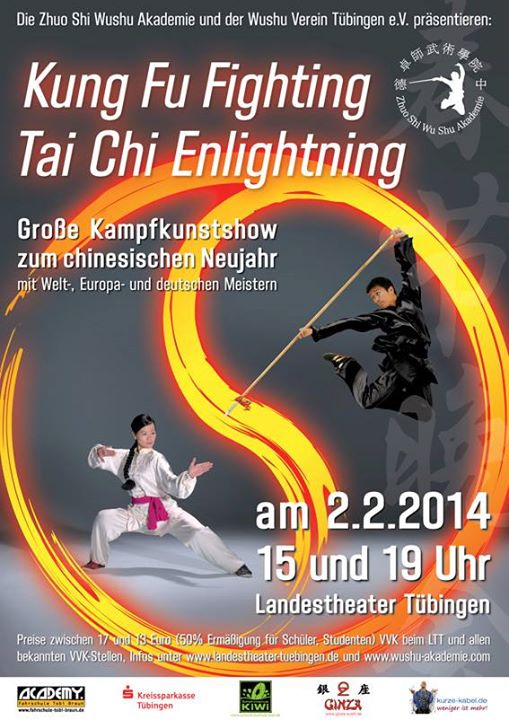
After lunch we were in for a little show – some members of a nearby Wu Shu academy came by to do an authentic dragon dance and various fight sequences with bare hands (and lots of kicks) or a variety of bladed weapons (with very flexible metal blades). The teacher that accompanied the (clearly not Chinese) students was Master Zhuo Haojun, who is a highly qualified Wu Shu trainer. Having not only won the Wu Shu World Championships (back in 1994), he has worked as a professional stuntman in Kung Fu movies (doubling even for such well-known names as Jet Li) and is the trainer of the German national team. We didn’t know all that in advance, but as soon as we first saw him move it was clear that he was extremely competent, and we would have loved to see more! I think his sister, who is equally well-qualified and founded the academy in Tübingen, was also there, but she mainly remained in the background, letting her brother take the spotlight. 

That’s the two of them there!


I think Dominic and I are both tempted to join a course at their academy – I particularly liked the loud slaps and stamps, especially when they’d do a high kick, slapping their foot loudly as it sped over their head, then bring it down with a loud stamp. It made for a very powerful rhythm.


That was my experience at the Chinese New Year celebration! 2015 is the year of the goat – or the sheep, or ram, depending on region or preference. The Chinese word yáng refers to both goats and sheep, and apparently the zodiacal yáng is more likely to be thought of as a goat in the south and a sheep in the north in China. 

The Year of the Sheep is believed to be a year of promise and prosperity, and the Sheep reflects the Earth and Yin: A passive or female principle, covert and shaded, soft and yielding. This year is considered a good one for family and creativity. Sounds perfect to me!