Showing posts with label festivities. Show all posts

Monday, March 9, 2015

Japanese Tea Ceremony


The other day I started reading up on the Japanese tea ceremony. It's such a complex and interesting tradition that I rapidly found myself caught up in it, reading about the tools, phrases, and of course, the tea.

The complex ceremony evolved due to the scarcity of tea from the Nara to the Heian period (794-1192), making tea a valuable and treasured beverage. From then on, the tea ceremony evolved until reaching the level of detail and sense of ritual that it has today. (Read about the influence of the Samurai and zen monks on the tea ceremony here!)

Called chanoyu (茶の湯), the Japanese tea ceremony is the ritualistic preparation of matcha (抹茶), powdered green tea. There is another, less common style using sencha - loose tea leaves like the ones we are familiar with. This tea ceremony is called senchado (煎茶道).
Matcha, however, is made from shade-grown tea leaves that are steamed and laid out flat to dry; as a result they crumble somewhat, and at this stage the tea is called tencha (碾茶). Tencha is also supposed to be very delicious, but if the tea leaves are taken and de-stemmed, de-veined, and ground, then you end up with matcha - a fine, vivid green powder that has great health benefits. One glass of matcha supposedly equals 10 glasses of regular green tea in terms of nutritional value and antioxidant content. Impressive!

If you had a look at the kanji (Chinese symbols), you'll have noticed that each one contains the kanji , cha, which means tea. Japanese people will respectfully call tea "o-cha", as O is a prefix that shows respect. "O-cha" in Japan tends to refer to green tea, and Western black tea is commonly referred to as "koucha" (紅茶), which literally means "red tea".

Interestingly, matcha has experienced a surge in popularity outside Japan, being sold the world over in matcha lattes, chocolates, cakes, and a variety of other forms. If you should want to try matcha yourself, there's a very thorough and interesting review of matcha brands here!


The tea ceremony, however, remains an integral part of Japanese culture. 

I found it fascinating to read about the chanoyu (tea ceremony with matcha), and watched this video showing tea being prepared for two women. It takes a little while for things to be set up, so if you skip to 5:30 you'll see the woman preparing the tea (called a Teishu - the host of the tea ceremony) carefully folding a cloth napkin to wipe the lid of the container holding the matcha powder. The way she folds the cloth with slow deliberation into a shape that reminds of origami, then wipes the lid with careful strokes in the shape of the letter ko, , is captivating. Each gesture is clearly choreographed, the weight of tradition behind it.

Also of particular interest to me are the phrases and expressions used during the ceremony; it's a choreographed conversation between the Teishu (host) and Shokyaku (main guest), with only occasional comments between the guests. The Shokyaku, regardless of how many guests are present, is the only one to speak with the host.

Then, there are the items that the guests carry on them - if in the video you skip to 11 minutes, you'll see the younger guest pull a napkin out of the overlap of her kimono at chest height, proceeding to use it as a sort of dish to eat one of the provided candies. I was so surprised when she pulled the napkin seemingly out of nowhere!


There is a lot more to say about the tea ceremony, but these are the main points that were interesting to me. I definitely want to enjoy a proper cup of matcha someday! If you want to read more about the chanoyu, I highly recommend the webside www.japanese-tea-ceremony.net.

Wednesday, March 4, 2015

Bindi

Today I was reading up a bit on the bindi and tilaka, two forehead markings that characterize, but are not limited to, Hinduism.

The red dot on this lady's forehead is a bindi, a decoration worn in South and Southeast Asia.
I got onto this topic when reading about Indian widows celebrating Holi, the festival of colors. The topic matter is both saddening and horrifying (as apparently in some places widows are cast out and shunned after the deaths of their husbands), but I found myself intrigued by the markings on their foreheads. I knew about the bindi, of course, but the long, silver or gold markings surprised me. (To see the photos, click on the link - both the text and photos are worth a few minutes!)

Looking into it a bit, I found that the markings must be what is called tilaka, and presumably they only applied the color for the festival, though it's also possible that they wear it on a daily basis. The different styles of tilaka (or sect-markings) are quite neat, and though I didn't recognize any of the markings below on the photos, here are an assortment of tilaka styles as found on wikipedia:


While I could not quite figure out the origin or meaning behind the tilaka, the placement of both it and the bindi on the forehead is due to the sixth chakra, ajna, being positioned there. As such, the bindi represents the third eye.

Interesting, no? If anyone knows more about this, I'd love to hear about it! Comments are welcome.

Tuesday, February 24, 2015

Chinese New Year

I live in Tübingen, a rather international German city despite its relatively small size, and there are a number of Chinese families living in our area. With my mother’s help, these families got together and organized a New Year celebration on the 21st of February that we were all invited to attend!


At midday on Saturday we made our way over to the gathering place to find it overrun with adorable, cheery-faced Chinese kids – I don’t think a single one of them was over the age of eight! So sweet.
The parents were either hanging up decorations (like this, for example) or preparing dough and fillings for dumplings, which would then be prepared by everyone together – guests included!

Just before we started making dumplings, I realized I hadn’t thought to bring a camera and instead drew this with the only pen I could find. There were a lot more tables and a lot more people than pictured here!

Then people started gathering around the tables with mounds of dough and minced meat or carrot fillings; chopping, rolling and wrapping, and I joined some of my siblings at a table with some Chinese ladies. It was my first time wrapping dumplings, and a lady I already knew from one of Mom’s English groups, Dan (yes, that’s her real name), showed me the trick to wrapping Chinese dumplings. I tried to draw the process, but was unsure how to properly show the trick to folding over the dough. You can check out a blog post with many excellent photos here!

One of the Chinese ladies liked it so much that she took a photo. It’s so poorly drawn, though!

There were so many dumplings to be wrapped that finished and cooked (boiled) dumplings were being brought out even as we wrapped more – but oh, were they good! The meat filling had celery in it, which I typically don’t like but enjoyed in the dumpling, and the carrot filling was equally delicious. To dip we had what I believe was a soy sauce and vinegar dip, with garlic added for a bit of extra zing. There were side dishes of radish salad and cold rice noodles.

In Korea, they say that wrapping beautiful dumplings for the New Year means that you’ll have beautiful daughters; I don’t know if it applies to Chinese dumplings wrapped shortly after the New Year, but Anastasia and my dumplings were very beautiful indeed! Interestingly, Chinese dumplings supposedly symbolize wealth because their shape is similar to that of a Chinese sycee – a gold or silver ingot currency used in China until the 20th century.


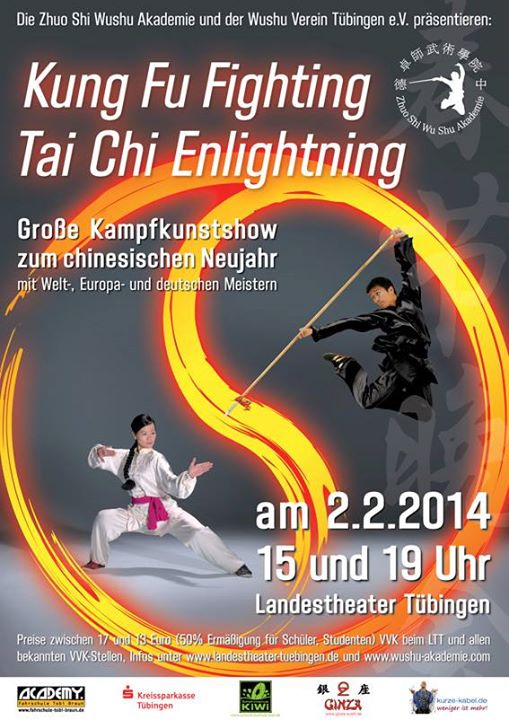
After lunch we were in for a little show – some members of a nearby Wu Shu academy came by to do an authentic dragon dance and various fight sequences with bare hands (and lots of kicks) or a variety of bladed weapons (with very flexible metal blades). The teacher that accompanied the (clearly not Chinese) students was Master Zhuo Haojun, who is a highly qualified Wu Shu trainer. Having not only won the Wu Shu World Championships (back in 1994), he has worked as a professional stuntman in Kung Fu movies (doubling even for such well-known names as Jet Li) and is the trainer of the German national team. We didn’t know all that in advance, but as soon as we first saw him move it was clear that he was extremely competent, and we would have loved to see more! I think his sister, who is equally well-qualified and founded the academy in Tübingen, was also there, but she mainly remained in the background, letting her brother take the spotlight. 

That’s the two of them there!


I think Dominic and I are both tempted to join a course at their academy – I particularly liked the loud slaps and stamps, especially when they’d do a high kick, slapping their foot loudly as it sped over their head, then bring it down with a loud stamp. It made for a very powerful rhythm.


That was my experience at the Chinese New Year celebration! 2015 is the year of the goat – or the sheep, or ram, depending on region or preference. The Chinese word yáng refers to both goats and sheep, and apparently the zodiacal yáng is more likely to be thought of as a goat in the south and a sheep in the north in China. 

The Year of the Sheep is believed to be a year of promise and prosperity, and the Sheep reflects the Earth and Yin: A passive or female principle, covert and shaded, soft and yielding. This year is considered a good one for family and creativity. Sounds perfect to me!

Saturday, February 14, 2015

Happy Valentine's Day!

I have plans for today, so I doubt I'll be posting later! So, without any ado, have some little images I made. Happy Valentine's Day!


Monday, February 9, 2015

Hallowtide

Some time ago, I had reason to read up on the origins of Halloween, and found myself drawn into the concept of the triduum of Hallowtide.

I don't think I had ever properly learned about it; indeed, as far as I know, All Souls' Day isn't even observed in Germany. So it was fascinating to read up on the triduum and the various customs that are, or were, observed.

I particularly liked the concepts of "souling" and "guising" - the first involves groups of people going around begging (or singing) for soul cakes, in return praying for the souls of the givers and their friends. Guising, on the other hand, has children going from house to house performing small party tricks such as reciting a poem or singing a song in exchange for money or food. A rather more interesting variant on the American trick-or-treating, guising is popular in Scotland and Ireland, and also involves costumes.

Personally, I'm always interested in food and song, so reading up on the practice of souling (which was popular in England from the medieval period up until approximately 1930) was more interesting that guising to me.

"Soul cakes" are small round cakes that are given out to soulers, and each cake eaten is said to represent a soul being freed from Purgatory. They're traditionally filled with allspice, nutmeg, cinnamon, ginger or other sweet spices, raisins or currants, and before baking are topped with the mark of a cross (often a simple one made with a knife). It seems that souling tended to take place on All Saints' and All Souls' Eve, and children and beggars would go around singing for soul cakes. I found a score and some lyrics for what appears to be a (or the?) traditional song. Check it out here!
And speaking of songs for All Saints' Day, also quite nice is the hymn "For All the Saints".

I find interesting that All Hallows' Eve is believed to be an eve where the veil between the material world and the afterlife is thinned, and thus in some cultures people visit the graveyards on this eve, placing flowers and candles, while in Wales this night is Nos Galan Gaeaf, when people avoid churchyards, stiles, and crossroads, as spirits are thought to gather there. There are many other practices in other cultures, of course, but this struck me as particularly interesting as Wales is so close to countries that observe the triduum of Hallowtide.

All Saints' Day is the 1st of November, and was referred to as Hallowmas by such characters as Shakespeare, though some have used the word Hallowmas to refer to the entire triduum of Hallowtide. There is some speculation as to why All Saints' Day is now observed on the 1st of November - some believe that it was chosen in the British Isles to replace or coincide with the Celtic festival of the dead, Samhain, but according to Oengus of Tallaght, All Saints' Day was once celebrated on April 20th. Interesting!

All Souls' Day, then, is celebrated the day after All Saints' Day - on the 2nd of November. It's a day of prayer for the dead, to complement the preceding day of the saints. Souling, ringing bells, and lighting candles to relieve the spirits in Purgatory came to be associated with this day.

Personally, I'd enjoy observing a few of the customs; learn the songs, bake soul cakes, bob for apples... (I never have before!) Maybe this year, in 2015, I'll try something a bit different around Halloween. After all, it's not like the Americanized celebration ever really made its way to Germany! (Though I will admit to enjoying a goth party on Halloween of 2014.)

We'll see! It's interesting, that's for sure. I think I'll read up on the four Gaelic seasonal festivals next, since Samhain is celebrated right around the same time. I'd be happy to hear comments of what you know about Hallowtide!